
By Tallon Smith
For those fanatical enough to wade through the tide of off-season ‘top 10’ and ‘best of’ articles from this year, one press release may have stood out more than others. Following the slow death of pre-season football to closed trials played in training kits, the NRL has decided to regain control of the trial schedule to form a pre-season challenge, much like the Ampol, Wills and Lotto Cups and the Tooheys Challenge of years ago.
For many years, the NRL regularly scheduled multiple trials in regional areas. This has had a massive impact by way of reviving and increasing interest in the game in country towns and cities where football is the lifeblood of the community.
However, even with regard to three of the most challenging years in many people’s lifetimes and in the face of a growing incursion from the AFL turning our rugby league heartlands into an extension of Victoria, the advent of this new pre-season competition has failed to see matches moved from being played in front of 100 people in suburban Sydney to appreciative crowds of thousands in regional areas.
The main issue with this is that Sydney already hosts well over 60 premiership matches each year. Obviously, given that many clubs already struggle to sell tickets to these games (don’t get me started on Thursday Night and Friday 6pm games), there is an oversupply of matches in Sydney for the casual fan. Given that there are eight clubs (plus half of St George Illawarra’s games) in Sydney, the appetite for lower-standard February football is not necessarily ever going to be substantial in Sydney.
However, contrast this to a smaller regional centre, such as Griffith or Armidale. Sure, larger rural cities such as Wagga Wagga, Tamworth, Bathurst and Dubbo may all get a regular season match for points throughout the year, but the distance from some of the smaller locations still prevents many from seeing their favourite athletes and childhood heroes gracing the turf in real life.
Only Mudgee and Moruya are hosting trials in regional NSW this year, with Mudgee’s being part of a multi-year agreement to host the Charity Shield. The Moruya match, hosted by Canberra, is perhaps the most important of the fixtures of this year’s pre-season, given the sharp decline of the once proud local club, the Moruya Sharks.
The fact remains however, that fewer and fewer trials are being played in regional areas, which highlights the major problem that is the disconnect between struggling regional clubs and their cashed up professional counterparts.
So, my solution? Well, given that there are nine trials being played in Sydney and surrounds (excluding the World Club Challenge, which is obviously a major fixture and should be played in Penrith), the fixture could be reorganised to avoid empty suburban amphitheatres in Sydney. First and foremost, the Belmore Double Header needs to go. Given that the Bulldogs are playing two fixtures there in 2023, including one in Round 3, just weeks later. The Tigers v Raiders fixture therefore could be allocated to Armidale, where a packed Bellevue Oval would be a certainty. Then, the Bulldogs v Sharks fixture could be allocated to Albury, at the redeveloped Lavington Sports Ground.
Then, Gosford, which is receiving two double headers plus a Roosters regular season fixture could do without the second lot of two matches. This could see the Knights v Eels game moved to Taree or Port Macquarie, and the Roosters v Sea Eagles game rescheduled to Orange. Both of these locations would ensure bumper crowds instead of a near empty Central Coast Stadium.
Finally, the Battle of the West and Grand Final rematch, to be played at Penrith the week before the World Club Challenge, also should be relocated. Although it sounds controversial on the surface, given that Penrith are hosting a major international club the following week and the opening Friday Night Football fixture for 2023, relocating the fixture to Griffith would be the most logical option. This would not only reserve the appetite of the Golden West for the St Helens match and the regular season, but would also breathe much needed oxygen into the suffocating Group 20 competition, which has declined along with a corresponding rise in the Victorian code in the area.
This is not rocket science, it is a simple method to protect and nurture the game across regional NSW. And that is what needs to be at the forefront of every decision made regarding the game across the state.
Because of this, the idea that local councils should have to fork out six figures to host otherwise unwanted matches in Sydney is ludicrous. Given the struggles of the game in regional New South Wales in recent years, the NRL footing the bill for players and television crews to make their way out to play matches in the country is perhaps the most important and easy way for the NRL to protect its greatest asset, people.
For decades, the AFL have worked tirelessly to grow their sport outside of Victoria, scheduling pre-season games across the country, including on the frontline of the code war with rugby league in Narrandera and Wagga Wagga. But, unlike rugby league, who have scheduled a game in Geelong to grow the game ahead of their return to NRL Victoria competitions through the Geelong Sharks, the AFL continues to protect their heartland through scheduling pre-season fixtures everywhere from Colac to Wangaratta and Bendigo to Morwell, ensuring kids meet their heroes and are converted for life.
Plain and simple, aside from potential revenue sources for local clubs and leagues via canteen and bar sales, the number one priority is to make sure kids are idolising Latrell Mitchell, Tom Trbojevic, Nicho Hynes and James Tedesco instead of Buddy Franklin and Toby Greene. Ensuring that there are bountiful numbers of budding rugby league fans is the biggest challenge for this great game in regional areas at present, and if this can be achieved, all else will follow on from there.
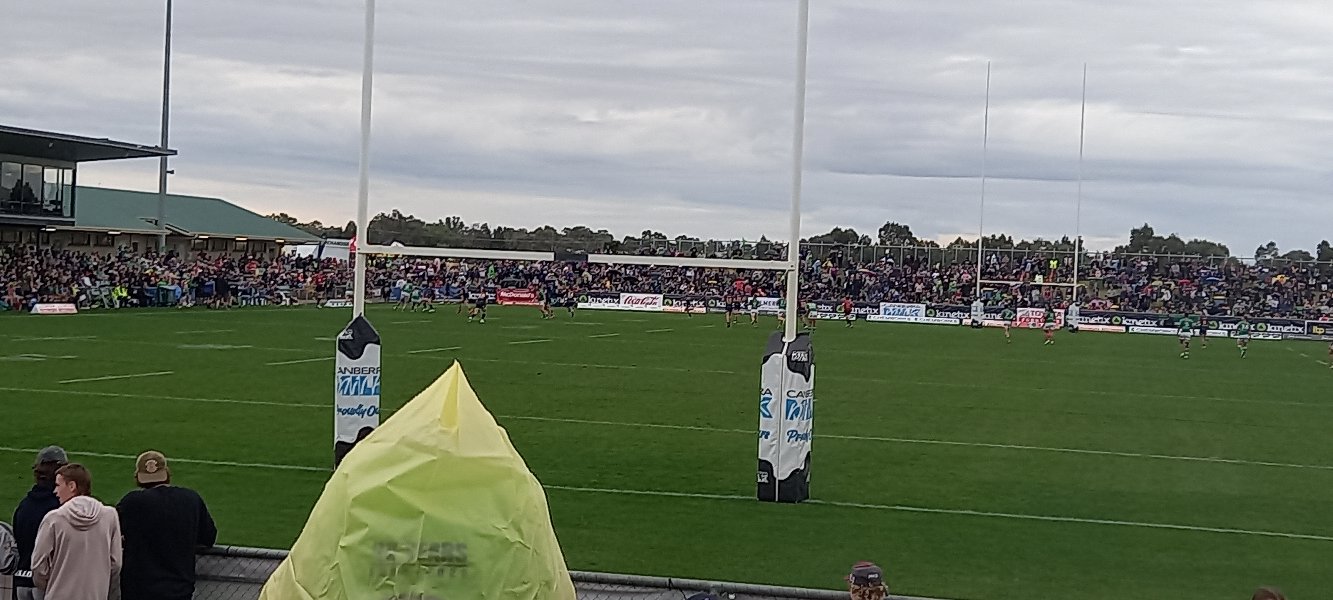
Cover Photo: A view from the hill at a sold-out Telstra Premiership match in Wagga Wagga earlier this year
 Battlers For Bush Footy