
SPOTLIGHT: EVERY ROUND IS MAGIC ROUND
by Tallon Smith
Out in the parched semi-arid plains west stretching from the Murrumbidgee Irrigation Area to the Central Darling Shire and beyond, a competition has proved that age, distance, finances, past misdemeanours and the prolonged decline of rural towns is no barrier to footy. In fact, the people of Barellan, Goolgowi, Hillston, Ivanhoe, Narrandera and Rankins Springs believe that those factors make footy all the more important.
These people haven’t always had it their own way, you see; for twelve painstaking years there was no rugby league in the district due to drought, dwindling club numbers and pure bureaucracy.
“When Hay left and went to Group 20, that was the ultimate killer, [but] what happened was Group 17 still wanted to play, but [the] Country Rugby League wouldn’t allow us to play with four teams,” says Brent Parsons, the President of and winger for the Rankins Springs Dragons.
“There was Rankins Springs, Goolgowi, Hillston and Euabalong [left].”
Following this, rugby league figures aimed to bring the game back to the region through entering a combined team in their much stronger neighbour, Group 20. “Back in the day when Group 17 folded, it was about a year or two after, there was massive talk of putting a Group 17 side in Group 20,” Parsons recalled.
“There [were] meetings about it…my father had a fair bit to do with it.” But in the end, it was a false dawn he said, as “it got shut down by Group 20.”
Ten years passed before any further serious discussion about reforming football in the area in some form. However, undeterred by previous setbacks, emerging keen footballers from younger generations coming through and stalwarts from the district organised to meet for a discussion on the future, and, with the assistance and input of NSWRL Bidgee Area Manager Dave Skinner, the Proten Community Cup was born in 2018.
The competition was designed under a specific format to ensure its survival long-term. This involved the implementation of the Safeplay code to protect players of varying skill level aged “anywhere from 17 [to] 55” playing in the one men’s and one women’s grade, and strict amateurism to protect the fragile finances of the clubs involved. “Everyone you see here is playing for love, like you’re not playing for money,” Parsons explained.
“That’s what’s killing bush rugby league; money.”
The humility of the game in the area is refreshing, but the fragility is frightening.
“When we started up back in 2018 we had $190 left in the bank,” he said.
Parsons’ view on rugby league in the district is clear; money and spending is the issue.
“The problem with rugby league – well country rugby league – is, it’s dying, there’s no doubt about it,” he said after telling Battlers For Bush Footy that he knows of one club in a nearby competition which spent $100,000 on players alone for the 2022 season.
“Group 20 has been dying for the last 15 years,” he said, speaking on the competition’s vastly imbalanced match payments.
The Proten Community Cup model is simple, every club hosts one matchday per season, meaning every club travels to the one ground much like the NRL’s Magic Round, allowing for bumper post match functions, a larger gate revenue figure, and crucially, camping in Ivanhoe, the most isolated rugby league town in NSW.
The regular season features six rounds, with each team playing everyone once and their rival twice. This is usually bookended by a knockout and a three week, four team finals series, for a maximum of eleven games and a minimum of eight. Parallel to the Men’s Grade there is also a Women’s 9s competition which features five of the six clubs (Barellan being the exception).
Also central to the schedule in previous years was the Rankins Springs Ultimate Ressies 9s Day, where Proten Community Cup sides would play Group 20 Reserve Grade sides in a pre-season hitout. However, Parsons, the Rankins Springs club, and the entirety of the Proten Community Cup were shocked when Group 20 barred its clubs from competing.
“Group 20 blocked it this year,” he said. However, he did hint at the potential for Group 20 clubs to move across to the Community Cup in the future, maybe in a club swap with Narrandera.
Speaking of Narrandera, perhaps no club has benefitted as greatly from the re-creation of the competition as the boys in Green and Gold. Forced into recess from Group 20 in 2005 after dwindling player numbers and a series unfortunate incidents in the preceding seasons, the club briefly merged with the struggling Yanco-Wamoon Hawks in 2012 to form the ill-fated Bidgee Hurricanes, which disbanded as Yanco-Wamoon reformed as a standalone club in 2015.
However, the club was handed a lifeline when the Proten Community Cup was formed in 2018, and Captain-Coach Kye Longford couldn’t be more grateful for the opportunity.
“Its always good to come back and play with your hometown,” he said of playing with the Lizards, and although “[Aussie] Rules has taken over” in their absence, the return of senior football gives the town’s flourishing junior rugby league players “somewhere to step up to.”
On a potential return to Group 20, Longford said “that’s the end goal, we obviously don’t have a timeframe on it, but the sooner the better.
“When we do go back we want to have that support so that we’re not just there for a year and then we fold again.”
On the threat of Australian Rules, Longford said that the approach from both the Lizards and their counterparts the Narrandera Imperials was one of “supporting them, watching them succeed, and [them] doing vice versa.
“At the end of the day we’re just there to support each other.”
The Lizards, named after Narrandera’s First Nations meaning of ‘place of the lizards,’ are evidence of the positive impact of the Proten Community Cup upon the towns involved.
“I grew up idolising some of these guys that we’re playing with at the moment, and that’s all we’re about, we just need something for the juniors to aspire to. It’s vital that we have that senior competition here, and then we just prosper from that.”
Yet another advocate for the competition is Hillston Captain-Coach James Williams.
“It’s a good feeling once we’ve got the whole team on board,” he said. Although he hails from Griffith, an hour to the southeast of Hillston, Williams said he was proud to play for the Bluebirds as “all [his] family originated from Hillston.”
Although the club struggled early in the season with numbers, the addition of Group 20 veteran Luke Farmer and former Canberra Raiders fullback David Milne has helped the club immensely.
“We’ve got a good twenty, twenty-two base blokes,” Williams said. He holds high hopes for the year, proudly proclaiming that the side will be “there on Grand Final day.”
Throughout Battlers For Bush Footy’s conversations with each of the three passionate players, one thing remained abundantly clear; it was massive to have footy back, and stable after five seasons. Although there may be many social, economic and geographic challenges to be faced by these small communities as they move into the future, one thing is for certain; footy is the greatest driver of community spirit on the plains.
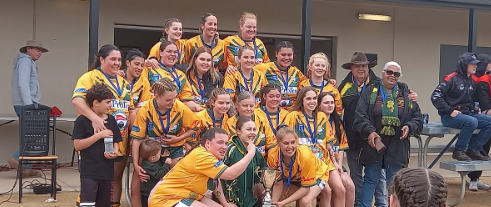
Pictured: Narrandera’s women’s team, 2022 Group 17 Proten Community Cup Premiers
 Battlers For Bush Footy